4 Tips to Grow Closer to Your Sponsored Child

As a child sponsor for over 3 decades, and now as the Child Sponsorship Administrator for Forward Edge, I am often asked (and challenged myself) about how to best communicate with a sponsored child.

In almost all cases, the children we sponsor live in other countries. We do live in a technologically advanced age with a myriad of electronic options and apps designed for communication, but for logistical reasons (and safety precautions) these methods are rarely viable or suitable for sponsor/child contact. Ultimately, the best way to communicate with our kids is through good old-fashioned letters (and e-mail, thank goodness).

How do I build a personal, meaningful relationship with my child?

1. Don’t get discouraged

Don’t be discouraged by what you think are the expectations of your sponsored child. I don’t know how many times I’ve found myself feeling guilty that I haven’t written enough, or made my letters creative and entertaining enough, etc. I’ve had sponsors worry that if they send an email instead of a hand-written letter it would be perceived as less personal, and the child’s feelings may be hurt; or, if a birthday greeting doesn’t arrive in time for the exact day, it would somehow be less important.

The truth is those assumptions are just not accurate. Most children in a sponsorship program are completely new to the experience and have no preconceived notions or expectations; they’re just excited that someone they don’t know has expressed a desire to know them, love them, and help them. This makes it easy to engage them with a light heart and no pressure.

2. Write often

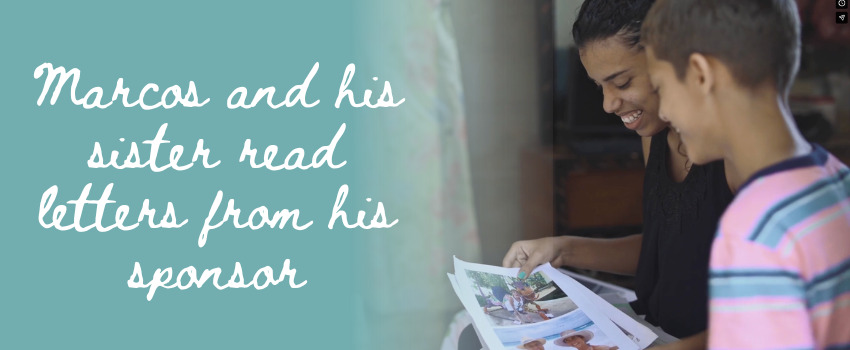
You may be wondering, “How often should I write?” I would say one or two letters a month is ideal to really help form that friendship. (But remember, if you cannot write that often, don’t worry; your child will appreciate whatever you can do.) Whether your letters are hand-written or typed on plain paper, or rainbow-colored and peppered with doodles and clip art, your child will cherish them, save them, and probably show them to you if you’re ever able to visit him/her.

3. Share Photos

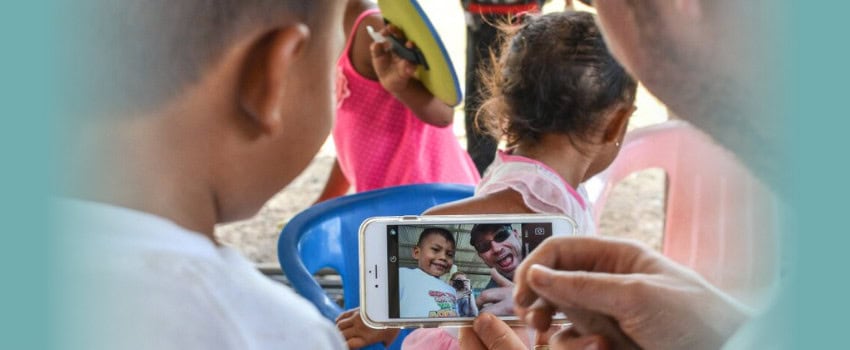
Children LOVE photos of you, your pets, your family, your city, etc. This brings them into your world. Postcards are great and personal pics are better. I like to take silly photos of myself sometimes and send them to my children; it makes them laugh. They probably think I’m a little nutty, and it’s true. In turn, they draw me pictures that include stick figures of us together, and I’m reminded that they also see me as a part of their lives.

4. Celebrate with them

Many children in other countries don’t get to celebrate birthdays or holidays the way we often do in the U.S., so, even the simplest acknowledgment of these occasions has a great impact. A card, store-bought or homemade, is a treat. A small toy delivered or a financial gift sent so that a clothing item or a pair of shoes can be purchased is a blessing. However you choose to bless your child on these occasions, you can be sure that it is greatly appreciated; and, if it is a little late to arrive, it really doesn’t matter. Just the fact that you remembered them makes them feel very special.

Your love will speak volumes.

Each of these tips, hopefully, encourages you that simply contact with your child is the most important thing; a handful of words, a prayer, a scripture verse speaks volumes to their heart.

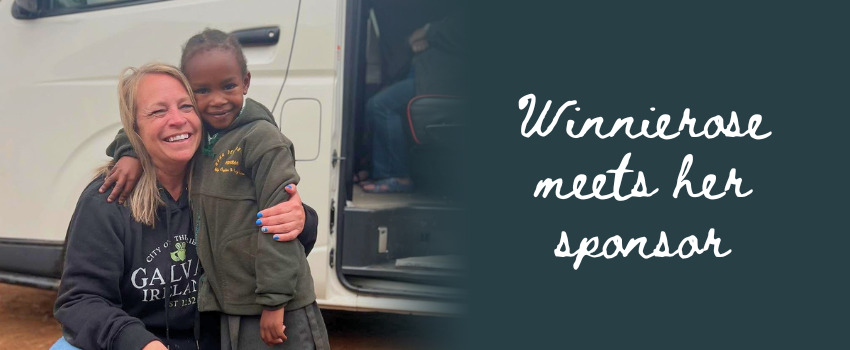
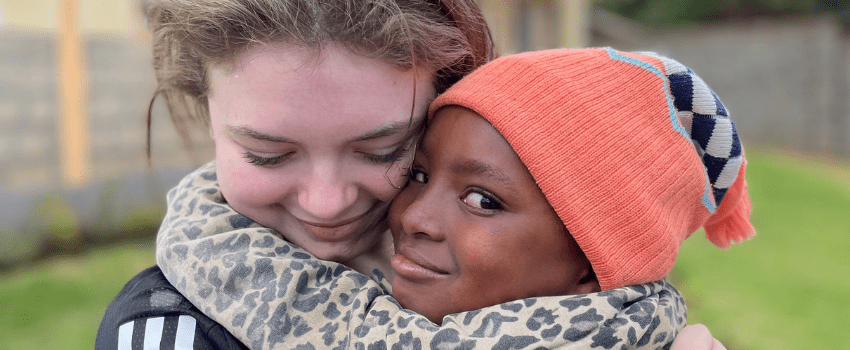
Of course, the ultimate way to bridge the distance—emotionally and physically—is by visiting your child. I know that this is a challenge for many sponsors who may not have the available time or money. Out of the many children I’ve sponsored over the years, I’ve only been able to visit one of them—and that was just last year. I can tell you, as many more will attest, that meeting your child face to face is one of the greatest joys in life. Being able to engage with them in their program, visit their home and meet their family, laugh with them and hug them is the best. Yes. The hugs are the best. Visiting your child is an investment but one that is worth making; and, usually, with some planning ahead, can be easier and more rewarding than you imagine.

When you and I think about sponsorship in the grand scheme of things, we’re not only giving financial aid to a child in need, we’re impacting a life through relationship—right now and possibly for eternity. We’re helping a child recognize their value and modeling how to value others. Never think that your gesture is too small or too insignificant. The small, and sometimes larger, ways that we engage our sponsored child communicates love to them—and it changes them, and us, for the good.

mission trips

Teens in Short-Term Missions

One of the most impactful things I learned as a teenager was that God will do extraordinary things through you whether you are 5 or 45, 15 or 52; He has no age restrictions and certainly does not follow the boundaries that we build up ourselves. Even now, at 21,

Go to Blog »
living on mission

Crazy Generosity

When you want something so badly – when you Love it, with a capital L – you’ll do anything to get it. Most of us can remember feeling like this at some point in our lives, whether it was a toy, a pet, a first car or a first love. 

Go to Blog »
child sponsorship

Berenice’s Letter

A special message from one of our sponsored children in Oaxaca, Mexico: Receive an affectionate greeting all of you. I would like to tell you a little bit about my life in Trigo y Miel Program. My name is Berenice Santiago Lugo. I have 5 siblings. Audre, Uriel, Joselyn, Dulce

Go to Blog »
post mission trip

Continuing Your Mission Back Home

I’m home from a life-changing mission trip. Now what? A short-term mission trip is an intense experience, in more ways than one. In the space of a week to 10 days, you’re immersed with a new group of people, develop a routine and learn new tasks and skills. You’ve also

Go to Blog »
Transform a Child's Life Through Sponsorship

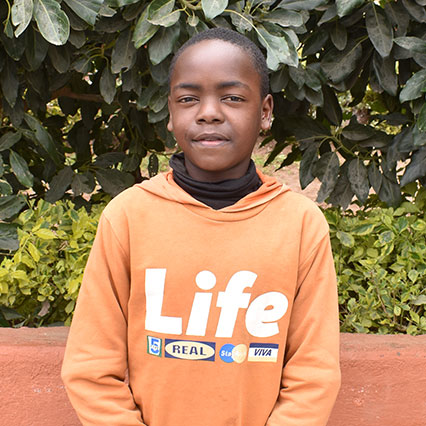
Habari (hello), my name is Humphrey

  • location

    Kenya

  • 7 yrs. old

    08-22-2018

Entered the program: June 2023

Humphrey lives with his grandmother, big brother, cousin, and uncle in a three-room plastered house with a cemented floor. They have an outdoor pit latrine that is in good condition. The family has electricity and they fetch water from a borehole.

Humphrey’s mother passed away from cancer in 2020. Humphrey’s grandmother took him and his brother, Peter, in after their mother's death. Humphrey’s grandmother doesn’t work and has no income; she relies on her son, as well as the Mama Beth program, to help provide for the children.

Humphrey’s brother, Peter, is also in the Mama Beth program.

Sponsorship Level What's this?

Three $38 sponsorships are needed to cover the complete holistic care of one child. Cover one, two, or three sponsorships.